Why Does My Breaker Keep Tripping? A Las Vegas Homeowner's Guide
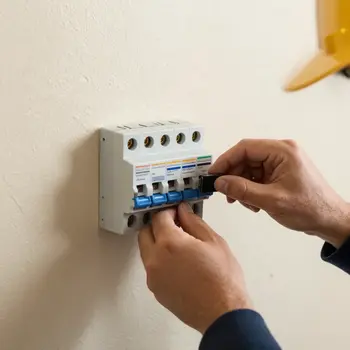
It's 112 degrees outside, the AC kicks on, and the house goes quiet. You walk out to the panel, flip the breaker back, and twenty minutes later it happens again.
If your breaker keeps tripping, the breaker usually isn't the problem. It's the messenger. A breaker is built to cut power when too much current flows through a circuit or when something unsafe is going on. When it trips over and over, it's telling you something on that circuit needs a closer look.
Las Vegas summers make this more common than in most places. AC units run for hours at a stretch, and they're sharing the load with refrigerators, pool pumps, EV chargers, and everything else in the house. One trip on a hot afternoon might just be a heavy moment. A breaker that trips every day is a different story.
What a Tripped Breaker Is Actually Telling You
Every breaker in your panel watches the current moving through its circuit. When that current climbs past a safe level, or the breaker picks up certain faults, it shuts the circuit off before the wiring overheats.
So the trip itself is a warning, not the root cause. Resetting it again and again without finding out why just lets the real problem keep going.
The 5 Most Common Reasons a Breaker Keeps Tripping
When the breaker trips can tell you a lot about why. Here are the usual suspects.
1. The Circuit Is Overloaded
This is the most common cause, and the least worrying. A circuit can only handle so much. In a lot of kitchens, one circuit feeds several outlets, so running the microwave, toaster oven, and coffee maker at once can push it past its limit.
You're probably looking at an overload if the breaker trips right after you turn on a few appliances, holds fine once you unplug something, and there's no burning smell or visible damage. Spread those appliances across different circuits and see if it stops. If the breaker still trips with almost nothing plugged in, something else is going on.
2. There's a Short Circuit
A short happens when electricity finds a shortcut it was never supposed to take, and a big surge of current rushes through. Damaged or worn-out wiring, loose connections, bad outlets, frayed appliance cords, and appliances failing internally can all cause one.
The telltale sign is a breaker that trips the instant you switch something on. Don't keep resetting it. Shorts create heat fast, and that's a fire risk.
3. There's a Ground Fault
A ground fault is when current leaks out of its normal path and heads to ground. These tend to show up where water and electricity are close together: bathrooms, kitchens, garages, laundry rooms, outdoor outlets, and pool equipment.
That's why those areas are protected by GFCI outlets, which cut power quickly when they sense that leak. If a circuit near a wet area keeps tripping, don't write it off as a simple overload.
4. The Breaker Itself Is Wearing Out
Breakers have moving parts, and they don't last forever. Years of trips or exposure to heat can make one unreliable.
A failing breaker might trip under a perfectly normal load, feel warm to the touch, refuse to stay on, show visible damage, or trip at random times. An electrician can test it and tell you whether it needs replacing. Just swapping the breaker without checking the circuit can miss what actually wore it out.
5. The Panel Can't Keep Up With the House
A lot of older panels were sized for a very different kind of home. Think about what a typical house runs today: central air, a second fridge in the garage, an electric range and water heater, a pool pump, maybe an EV charger, plus a home office full of computers.
An older panel may simply not have the capacity for all of that. Depending on the house, the fix could be a new dedicated circuit, moving some loads around, or a full panel upgrade.
Why Las Vegas Homes Run Into This More Often
The Heat Keeps the AC Running Constantly
For most homes here, the air conditioner is the single biggest electrical load. In July and August it barely shuts off. That long, steady demand puts stress on the wiring, the disconnect, and the panel, and it tends to expose any weak spot that was already there.
Many Homes Were Wired for a Different Era
Plenty of Las Vegas neighborhoods were built in the 1970s and 80s, when households used far less power. If you've since added central AC, an EV charger, a hot tub, pool equipment, a workshop, or a room addition, it's worth having the system checked. What matters is the actual condition of the wiring, not just the age of the house.
Some Older Homes Have Aluminum Wiring
During years when copper was expensive, some homes were built with aluminum branch wiring. It needs specific connectors and compatible devices, and connections can loosen over time. If you think your home has it, leave it to a professional. This is not a DIY job. You can read more on our wiring and rewiring page.
Federal Pacific and Zinsco Panels
These two brands turn up in older Las Vegas homes, and both have a long history of safety concerns. If you find one in your garage, don't assume a new breaker will fix things. Have the whole panel looked at.
Breaker Trips When the AC Turns On? Here's What That Means
If the breaker trips when the AC turns on, the timing points right at the air conditioner. The compressor pulls a big burst of power when it starts, so anything wrong in that system tends to show up at that moment.
The most likely causes are an overloaded AC circuit (the unit should be on its own properly sized dedicated circuit), a compressor that's aging or struggling to start, a failing capacitor (the part that helps the motor get going), loose or damaged wiring connections that build up heat, or a bad or mismatched breaker.
If the AC breaker trips right away or keeps tripping, turn the system off and get it inspected. And whatever you do, don't put in a bigger breaker to make the trips stop. The breaker size has to match the wire and the equipment. Upsizing it takes away the protection that's keeping that wire from overheating.
What You Can Safely Check on Your Own
You can gather a lot of useful information without opening the panel or touching any wiring.
Start by finding which breaker tripped. Leave the panel cover on. Then think back to what was running right before it happened. Was the AC starting up? Were you cooking with several appliances going? Did you just plug in something powerful, or run outdoor equipment? Did it happen after rain?
If an overload seems likely, unplug whatever you don't need on that circuit and keep high-power appliances off the same line.
Then pay attention to the pattern and write it down. Note which breaker, what was running, roughly what time, whether the AC was on, and whether it tripped instantly or after a few minutes. An electrician can use that to narrow things down much faster, which usually means a shorter (and cheaper) visit.
Stop right there if you notice burning smells, smoke, sparks, scorch marks, melted plastic, a panel that's hot to the touch, buzzing or crackling, damaged wires, or a breaker that won't stay on. Those need a professional.
When to Stop Resetting the Breaker
If you've unplugged the obvious loads and it still trips, stop resetting it. Forcing it back on doesn't fix anything.
Call an electrician if the breaker trips immediately, keeps tripping, or won't reset at all. The same goes for a burning smell, a hot panel, discoloration or scorch marks, buzzing or crackling, an AC breaker that trips again and again, or several breakers starting to trip. If you already suspect your panel is outdated, get it checked sooner rather than later. If anything seems dangerous, don't wait. Reach out to an emergency electrician.
Losing power on one circuit for a day is annoying. It's a lot better than the alternative.
How an Electrician Fixes It
The fix depends on what's behind the trips.
Replacing the Breaker
If testing shows the breaker has failed, it gets replaced with the correct type and rating. A good electrician will still check the circuit to see why it failed.
Learn About Breaker RepairAdding a Dedicated Circuit
When one appliance is overloading a shared circuit, giving it a circuit of its own often solves the problem. This is common for AC units, electric ranges, EV chargers, water heaters, and garage equipment.
Call Now (702) 899-7099Upgrading the Panel
If the panel doesn't have enough capacity, is badly worn, or can't safely support the home, an upgrade may be the right call. The decision depends on your home's load, service size, wiring, panel condition, and what you plan to add in the future.
Learn About Panel UpgradesWhat Does It Cost?
Prices vary a lot based on the problem, the equipment, how easy things are to reach, labor, and permits. As a rough guide:
| Repair | Rough Range |
|---|---|
| Diagnostic / service visit | $100–$250+ |
| Circuit breaker replacement | $150–$350+ |
| Dedicated circuit installation | $300–$1,000+ |
| Panel replacement or upgrade | $1,500–$4,000+ |
Treat these as ballpark numbers, not quotes. An electrician should look at your system and give you a firm price before starting any work.
Three Situations We See All the Time
The Kitchen That Can't Handle Breakfast
The breaker trips every time the microwave and toaster oven run together, and everything's fine once one is unplugged. That's a classic load issue. The long-term fix is changing how those appliances are powered, not flipping the breaker every morning.
The AC That Won't Start
Every time the air conditioner kicks on, the breaker trips almost immediately. The homeowner resets it a few times and it keeps happening. Because it's tied to AC startup, the AC circuit and the unit itself need to be inspected. A bigger breaker is not the answer.
The Random Trip With a Warning Sign
A breaker trips with barely anything running, the panel feels warm, and there's a faint burning smell. This one is not a DIY project. Leave the circuit off until it's been professionally checked, and consider booking an electrical inspection.
A Few Habits That Prevent Repeat Trips
Frequently Asked Questions
A short circuit, ground fault, worn-out breaker, wiring problem, or faulty appliance can all trip a breaker even when the circuit isn't carrying much load.
Usually it's a problem inside the AC system (like a struggling compressor or bad capacitor), too much demand on the circuit, a wiring issue, or a problem with the breaker itself.
No. If it keeps tripping, something is wrong, and resetting it repeatedly lets that problem continue. Find and fix the cause first.
Yes. A failing breaker can trip under a normal load. The circuit should still be tested before the breaker is replaced.
Not always. Often a new breaker, a circuit repair, or a dedicated circuit takes care of it. A panel upgrade makes sense when the current system can't safely handle what your home needs.
It depends on the cause. A simple breaker replacement usually runs a few hundred dollars, while a new dedicated circuit or panel upgrade can cost quite a bit more.
The Bottom Line
When a breaker keeps tripping, your electrical system is flagging something. Sometimes it's just too much running on one circuit. Other times it's a short, a ground fault, a worn-out breaker, bad wiring, or a panel that's been outgrown.
In Las Vegas, keep a close eye on trips tied to your AC, since summer puts real strain on home electrical systems. It's fine to note which breaker tripped, unplug extra devices, and track when it happens. Just don't open the panel, and don't keep resetting a breaker that won't stay on.
If you notice burning smells, heat, sparks, scorch marks, buzzing, or a breaker that refuses to reset, leave that circuit off and have a licensed electrician take a look. Call (702) 899-7099 to get connected with a local Las Vegas electrician.